
Why a Valid IBAN Does Not Guarantee a Successful Transfer: Limits of IBAN Validation
What does IBAN validation actually prove? Learn what MOD-97 can detect, what it cannot verify about account ownership, and which checks reduce transfer risk.
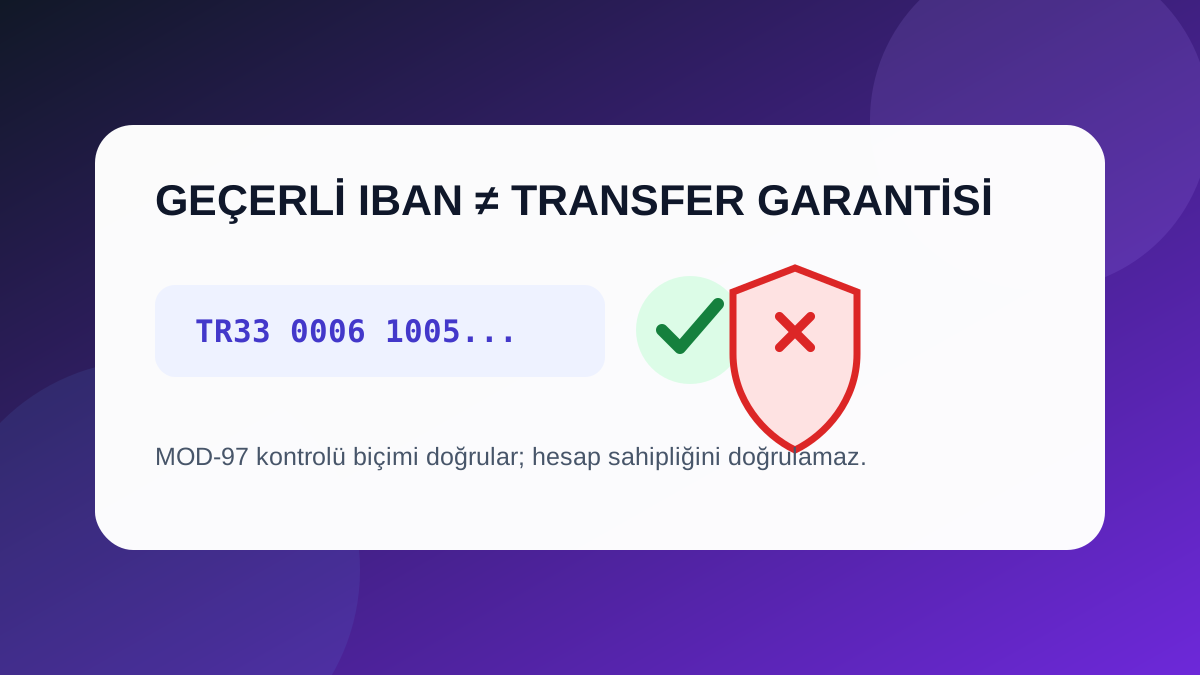
You enter an IBAN into a validator and the result says “valid.” Does that mean your money is guaranteed to reach the right person? No.
IBAN validation is a useful first-line check, but it has a specific technical scope. A validator can examine the country code, expected length, character pattern and mathematical check digits. None of those checks, by themselves, prove that the account is open, belongs to a named beneficiary or will accept your payment.
This guide explains what “valid IBAN” really means and which additional checks matter before you authorize a transfer.
What does an IBAN validator actually check?
IBAN stands for International Bank Account Number and is standardized under ISO 13616. It begins with a two-letter country code and two check digits, followed by a country-specific BBAN structure containing domestic bank and account components.
A technical IBAN validation process can typically check:
- Country code: Do the first two characters correspond to an IBAN country or territory?
- Length: Does the number have the official total length for that country?
- Character pattern: Are letters and digits used in the expected positions?
- Checksum: Does the IBAN pass the MOD-97 mathematical check?
- Country-specific structure: Where reliable reference data is available, do domestic bank or branch components follow the registered structure?
SWIFT acts as the registration authority for ISO 13616 and publishes the IBAN Registry, which describes official national IBAN structures.
What is the MOD-97 check?
IBAN check digits are validated using the ISO 7064 MOD-97-10 method. In simplified terms, the process:
- moves the first four characters to the end,
- converts letters to numeric values,
- calculates the remainder when the resulting large number is divided by 97.
A valid IBAN must satisfy the required mathematical result.
This is excellent at catching many common typing errors, such as a changed digit or transposed character. However, MOD-97 is not an identity-verification system. It proves that the character sequence is mathematically consistent with its check digits, not that a bank has opened a real account with that number.
What does a valid IBAN not prove?
It does not prove that the account exists
It is possible to construct an IBAN with a valid checksum and correct national format even when no corresponding live account exists at the bank.
It does not prove that the account is open
An IBAN may once have belonged to a real account that has since been closed, frozen or otherwise made unable to receive payments.
It does not prove the account holder's identity
The account holder's personal or company name is not encoded in the IBAN itself. You cannot determine from the IBAN alone whether the account belongs to “John Smith,” “Example Ltd.” or another person.
It does not guarantee that the bank will accept the transfer
A bank or payment provider may reject or delay a payment because of sanctions screening, compliance controls, currency limitations, country restrictions, technical issues or the status of the beneficiary account.
It does not prevent fraud
A fraudster can provide a completely real, active and technically valid IBAN that belongs to the fraudster. An IBAN validator will correctly report that the IBAN is structurally valid even though the payment request itself is fraudulent.
Why finding the bank name is still not a guarantee
Some IBAN tools decode domestic bank-code fields and display an associated institution. This can be a useful cross-check, but it does not convert structural validation into account authentication.
Two limitations remain:
- Bank-reference data can change over time.
- Matching a bank code does not prove that a particular account is open or belongs to the intended beneficiary.
The same principle applies to BIC/SWIFT information. A BIC helps identify an institution; it does not prove ownership of an individual account.
Why the beneficiary name must be checked separately
Invoice fraud and business-email compromise often use real bank accounts. For example, an attacker may send a message that appears to come from a genuine supplier:
“Our bank details have changed. Please send all future payments to this new IBAN.”
The replacement IBAN may be perfectly valid. The problem is not the checksum—the problem is that the payment instruction is fraudulent.
For unusual bank-detail changes, confirm the request through a trusted channel you already know. Do not rely solely on the phone number or link contained in the suspicious message.
What does Verification of Payee add?
Some banking systems compare the beneficiary name entered by the payer with information associated with the destination account. In the European payments ecosystem, this approach is commonly referred to as Verification of Payee (VoP).
Name matching can reduce the risk of paying the wrong account, but availability and exact behavior depend on the payment provider, country and payment scheme. A mismatch or warning deserves investigation rather than being dismissed automatically.
When is IBAN validation useful?
IBAN validation remains extremely valuable when used for the right purpose. It can catch problems such as:
- a missing character after copy and paste,
- an extra digit,
- an incorrect country-specific length,
- an invalid checksum,
- a structural pattern that does not fit the country's registered IBAN format.
You can use our IBAN validator to check structure and checksum before you send a payment. The result should be treated as a technical validation result, not as proof of ownership or account status.
An eight-step checklist for safer transfers
1. Validate the IBAN
Start with format and MOD-97 validation. Do not knowingly submit a payment to an invalid IBAN.
2. Check the beneficiary name
Compare the expected recipient with the information shown in your bank's payment interface, invoice or contract.
3. Treat bank-detail changes as high risk
Messages asking you to replace a previously used IBAN are a classic target for business-email compromise fraud.
4. Use a second communication channel
For material payments, confirm changed instructions through a phone number or official channel that you already trust.
5. Investigate unexpected country or bank information
A foreign IBAN may be legitimate, but if the country or institution is inconsistent with what you expected, ask for an explanation before paying.
6. Check BIC/SWIFT information when requested
Use our Bank and SWIFT/BIC directory as a reference and, for high-value or unusual payments, cross-check with the bank's official information.
7. Do not ignore your bank's warnings
Beneficiary-name mismatches, fraud alerts and extra confirmation prompts are designed to reduce payment errors and scams.
8. Stop if you are being pressured
Fraudsters often create urgency. Messages claiming that you must pay “immediately” or lose access to a service should trigger additional independent verification.
What happens if I transfer money to the wrong IBAN?
The outcome depends on whether the destination account exists and on the banks' procedures. A transfer to a nonexistent account may be rejected or returned. A transfer to a valid account belonging to the wrong person can be much more difficult to recover.
If you notice an error, contact your bank as quickly as possible. The bank may attempt a recall or contact the receiving institution, but successful recovery cannot be guaranteed.
Pre-transfer verification is therefore more reliable than relying on recovery after the money has been sent.
IBAN validation vs bank-account verification
These terms should not be confused:
IBAN validation checks whether the number follows standard formatting, length, structure and checksum rules.
Account or beneficiary verification attempts to confirm information held inside banking systems, such as whether an account exists or whether the beneficiary name matches.
A public IBAN-checking service usually performs the first type of validation. The second type requires separate banking or authorized payment-service infrastructure.
Frequently asked questions
If an IBAN passes MOD-97, is it definitely a real account?
No. MOD-97 validates mathematical consistency. It does not query a bank's live account database.
Can I find the account holder's name from an IBAN?
Not from the IBAN standard itself. Beneficiary-name verification requires a separate service provided through banks or payment providers where available.
If the bank name matches, is the payment safe?
It is a useful cross-check, but it is not enough on its own. The account can still belong to a different person or be inactive.
Is IBAN validation pointless then?
Not at all. It is highly effective for catching many data-entry and structural errors before payment. The key is to understand what the result proves—and what it does not.
Conclusion
The safest interpretation of “valid IBAN” is: the character sequence passes the relevant structural and mathematical IBAN checks. It should not be interpreted as “the account is definitely open,” “the beneficiary is definitely the right person,” or “the transfer is guaranteed to arrive.”
Combine IBAN validation with beneficiary-name checks, independent confirmation of changed payment instructions, bank security warnings and BIC/institution checks where appropriate.
Sources
- SWIFT — ISO 13616 IBAN Registry: https://www.swift.com/standards/standards-resources
- SWIFT — Country-specific IBAN structure validation documentation: https://www.swift.com/swift-resource/12361/download
- European Payments Council — Verification of Payee and payment schemes: https://www.europeanpaymentscouncil.eu/
This article is for general information and does not replace account-ownership verification performed by a bank or authorized payment provider.